Published on The Good, the Bad and Your Parenting Journey
It is May Bank Holiday Monday and it is 11pm. Ryan is lying next to me absolutely convinced that the fan we bought last year is somewhere in the loft. I told him it was in the cleaning cupboard. Reader, it was in the cleaning cupboard.
We bought it originally for our daughter’s room, but her room stays cooler than ours so it has been sitting in there waiting for exactly this moment. It is now pointed directly at us and honestly, sleep might actually happen tonight.
Which would be lovely. Because our nearly-three-year-old is not what you would call a fan of sleep herself. We will be up around seven regardless of what time we actually drop off tonight. If you are reading this at a similarly ridiculous hour with similarly tired eyes, hello. You are not alone.
This is the blog that came out of that very glamorous Bank Holiday Monday experience. Because if you have POTS or dysautonomia, or you just run warm, or you are a parent lying awake in a stuffy room while your husband insists the fan is in the loft when it is absolutely not, this one is for you.
First Things First: What Is Dysautonomia?
Before we get to POTS specifically, it helps to understand the bigger picture. Dysautonomia is an umbrella term for conditions where the autonomic nervous system does not work the way it should.
The autonomic nervous system is the part of the nervous system that handles all the automatic things your body does throughout the day without you thinking about them. It is like a thermostat that regulates various bodily functions in response to changes in the body and the environment, including blood pressure when you stand up, heart rate when you run, sweating when you step outside in the heat, and movement of food through the bowels after eating.
In people with dysautonomia, that constant seamless dialogue between body systems breaks down. The responses are too big, too small, too slow, or simply wrong for the situation.
Dysautonomia is not one single condition. It is a family of conditions, and POTS is one of the most commonly encountered forms of it.
So What Is POTS?
POTS, or Postural Orthostatic Tachycardia Syndrome, is a condition where your heart rate increases by 30 or more beats per minute within 10 minutes of standing up. It is a form of dysautonomia that controls automatic body functions like heart rate and blood pressure.
In other words, your body’s automatic systems cannot keep up with the simple act of you standing up. Most people stand up and their body quietly adjusts without them ever noticing. With POTS, instead of adjusting smoothly, the heart rate shoots up, blood pressure drops, and you are left dealing with a wave of symptoms that can genuinely floor you.
Common symptoms include dizziness, palpitations, and exercise intolerance, typically brought on by the upright position and relieved when lying down. Other symptoms can include shortness of breath, chest pain, chronic fatigue, generalised weakness, heat intolerance, headaches, brain fog, muscle and joint pain, nausea, and abnormal sweating.
It is classed as an invisible illness. From the outside you might look absolutely fine. On the inside, you feel like you have just sprinted for a bus, and all you did was walk to the kitchen.
Why Heat Makes Everything So Much Worse
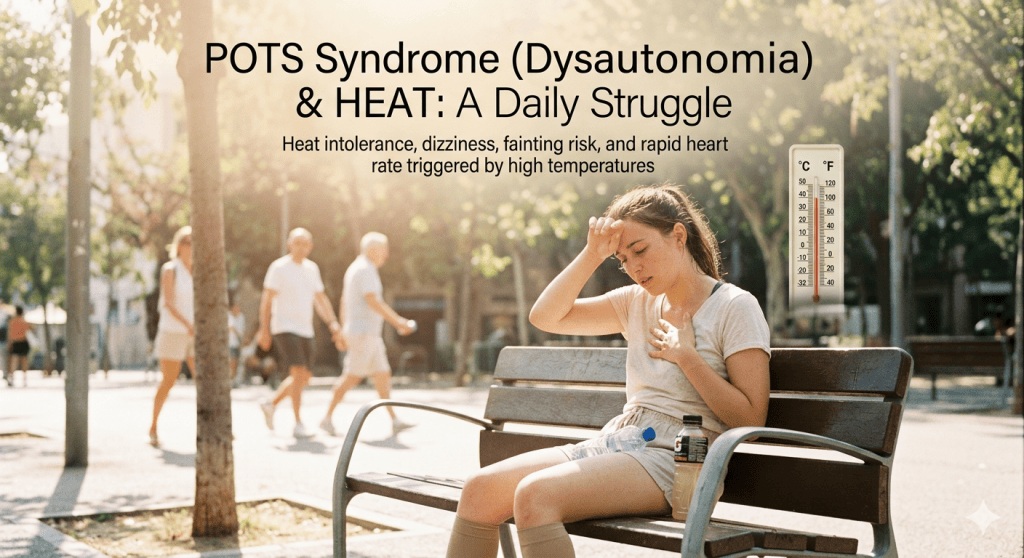
Here is the bit that a lot of people do not realise, even those who have been living with POTS for years. Heat is not just uncomfortable. It is a genuine physiological trigger.
Heat causes blood vessels to dilate and redirects blood to the skin for cooling. In conditions like POTS, this makes blood pooling worse and reduces blood pressure, which worsens symptoms.
Sweating too much, sweating too little, and temperature intolerance are all considered key manifestations of dysautonomia. Heat causes vasodilation, which in turn makes orthostatic intolerance and POTS symptoms worse.
Based on community polls, heat is one of the most common triggers for flare-ups and worsening symptoms. This is because of the thermoregulation difficulties some people with dysautonomia experience, in addition to the blood vessel widening that happens in warm environments, contributing to blood pooling and orthostatic intolerance.
So it is not that you are being dramatic when a warm afternoon floors you. Your body is genuinely struggling to manage something that most people’s systems handle automatically and invisibly. That is a really important thing to understand, both for yourself and for anyone around you who does not quite get it yet.
This matters enormously when you are a parent, because parenting does not pause for a symptom flare. The school run does not care that it is warm. Dinner still needs making. Life keeps moving regardless.
Enter: The Humble Fan
Okay, I know. A fan is not glamorous. It is not a cutting-edge medical device. It was, in our case, sitting forgotten in the cleaning cupboard while my husband was convinced it had somehow migrated to the loft.
But here is the thing. It works.
Maintaining a consistent temperature is important for people with POTS, as extremes, especially heat, can make symptoms worse. Air conditioning, cooling vests, handheld misters, and personal fans can all help.
A fan keeps air moving across your skin, which helps your body manage temperature without having to work overtime. For someone with POTS or dysautonomia, that reduced thermal load can genuinely be the difference between a functional afternoon and a full crash.
Here is how fans fit into real everyday life:
At home: A fan near your cooking space, your sofa, your desk. Keep the air moving so warm rooms do not become triggers before you even realise what is happening.
In your child’s bedroom: If your child has POTS or dysautonomia, a fan in their room overnight can make a real difference to sleep quality and morning symptoms.
At school: It is absolutely worth speaking to the school about having a small desk fan available for your child. Getting the school involved as early as possible and pushing the system when necessary is advice that comes straight from parents who have been there.
Out and about: Portable handheld fans are genuinely brilliant. Small, rechargeable, bag-sized. Choosing lightweight, rechargeable models makes them far easier to use throughout the day.
In the car: A small clip-on fan can help significantly if your child or you struggle with heat on school runs or longer journeys.
Other Cooling Strategies Worth Having in Your Toolkit
A fan is brilliant but it works best alongside other approaches.
Cooling towels, cooling vests, and portable spray fans can all help manage body temperature, especially in warm weather or during physical activity.
Keeping your environment cool, taking cool showers, or wearing breathable clothing may help ease dizziness and fatigue during warmer conditions. Worth noting: when showering, try to use lukewarm water rather than hot or cold, as either extreme can trigger POTS symptoms.
Hydration is the other big one. Adding sodium helps the body retain fluids and maintain blood volume, which can reduce dizziness and fatigue. Electrolyte tablets or adding a little salt to water throughout the day can help support this. Always check with your GP or specialist first, particularly for children.
Cooling vests, spritzing water on the face, or staying in air conditioning when it is hot outside are all recommended strategies for staying cool.
If You Are Parenting a Child With POTS or Dysautonomia
This section is for the parents doing it in real time, because this is a whole different layer of complexity on top of everything else parenting already asks of you.
The onset of POTS symptoms is usually in early adolescence, between 12 and 15 years of age, and more than 75% of patients are female. More than half of cases are preceded by an acute viral illness. So if your teenager seemed fine and then never quite recovered after a virus, POTS is absolutely worth raising with your GP.
Some practical things that genuinely help day to day:
Maintaining your child’s friendships is important. Think about doing things differently, such as having friends round instead of going out, dinner at home, craft afternoons, and using social media as a way to stay connected.
Believe your child. You cannot experience their symptoms, but you can see how they respond. They crave having more energy, and what you are seeing is real.
Keep records and take copies of letters and results to consultations. A short single-page summary with past medical history, medication, and symptoms listed in order of severity can be really useful to hand to clinicians.
And yes, put a fan in their bedroom. Put one on their desk. It costs very little and it can genuinely make their day more manageable.
If You Are a Parent With POTS or Dysautonomia
You are doing something extraordinary, even if it does not feel that way from inside the exhaustion of it. Managing your own condition while also managing the emotional, physical, and logistical demands of parenting is genuinely hard, and not enough people say that clearly enough.
A few things that can help on the harder days: plan your most demanding tasks for the cooler parts of the day, usually morning or early evening in summer. Keep a small fan in the kitchen because cooking over heat is one of the most common triggers. Taking short breaks when energy is waning and keeping your bedroom cool and dark for sleep can make a real difference to how you function overall.
Be honest with your children about what is happening in an age-appropriate way. You do not have to have all the answers. You just have to show them that you are managing something real, and that you have strategies. That is a powerful thing for them to witness.
The Bottom Line
POTS and dysautonomia are complex, often misunderstood conditions. The autonomic nervous system is doing a job most people never have to think about, and when it misfires, the ripple effects touch every single part of daily life.
But some of the most effective management tools are not complicated or expensive. Staying cool, keeping air moving, staying hydrated, pacing yourself. These are not small things. They are the foundations of a manageable day.
A fan is not a cure. Nothing is, right now. But it is genuinely useful, accessible, and low cost, and it can reduce your symptom load on warm days and give you back a little more of yourself. And when you are living with a chronic illness while also raising a small person who does not believe in sleep until nearly three, that matters more than words can really cover.
Now if you will excuse me, the fan is on, it is nearly midnight, and I am going to attempt to sleep before our daughter decides 7am is a perfectly reasonable start to a Bank Holiday Tuesday.
If this resonated with you, whether you have POTS yourself, you are raising a child with it, or you just needed someone to explain it all clearly, please share it with someone who might need it too.
And if you are not already part of our community, hit subscribe. We talk honestly about parenting, health, neurodiversity, and all the messy in-between bits. You belong here.
Have you found a cooling strategy that works for you or your child? Drop it in the comments. We all need each other’s tips.
References
Cleveland Clinic. (n.d.). Postural Orthostatic Tachycardia Syndrome (POTS). https://my.clevelandclinic.org/health/diseases/16560-postural-orthostatic-tachycardia-syndrome-pots
Mayo Clinic Connect. (2021). EDS and POTS. https://connect.mayoclinic.org/blog/ehlers-danlos-syndrome/newsfeed-post/eds-and-pots/
PoTS UK. (n.d.). Managing PoTS. https://www.potsuk.org/managingpots/
PoTS UK. (n.d.). Tips for Parents. https://www.potsuk.org/managingpots/tips-for-parents/
POTS Support. (n.d.). Navigating Heat. https://www.pots.support/navigating-heat
The Fibro Guy. (2026). POTS and Dysautonomia: Understanding and Managing Your Symptoms. https://www.thefibroguy.com/pots-dysautonomia-guide/
Di Bon, J. (2025). Beat the Heat: EDS, Hypermobility and Heat Intolerance. https://jeanniedibon.com/eds-hypermobility-heat-intolerance/
Re-origin. (2025). Heat Intolerance in POTS and Dysautonomia. https://www.re-origin.com/symptoms/heat-intolerance
Human Health. (2025). Natural Remedies for POTS in 2025. https://www.human.health/blog/natural-remedies-for-pots
Bloomfield Vein and Vascular. (2025). Tools to Manage Postural Orthostatic Tachycardia Syndrome. https://bloomfieldveinandvascular.com/medical-devices-for-pots-tools-to-manage-postural-orthostatic-tachycardia-syndrome/
Lurie Children’s Hospital. (2025). Living with Postural Orthostatic Tachycardia Syndrome. https://www.luriechildrens.org/en/blog/living-with-pots/
American SPCC. (2025). Your Daily POTS Checklist. https://americanspcc.org/your-daily-pots-checklist-self-care-tips-for-managing-symptoms-and-supporting-family-wellness/
This blog is written for informational and support purposes only and is not a substitute for medical advice. Always consult your GP or specialist regarding your own or your child’s condition.