Understanding Oesophageal Atresia and Tracheo-Oesophageal Fistula (OA/TOF): A Rare but Significant Condition

Every year in the UK, around 180 babies are born with Oesophageal Atresia (OA) and Tracheo-Oesophageal Fistula (TOF)—a rare congenital condition that affects the oesophagus (food pipe) and trachea (windpipe). Despite its frequency, awareness remains low, leaving many families feeling isolated when they receive a diagnosis.

For me, OA/TOF awareness is deeply personal. After giving birth to Amelia in Southampton, I met an incredible friend whose son has the rarest form of OA/TOF. We’ve seen the journey he and his family have been on—the surgeries, the challenges, and the victories. Now, he lives just a five-minute walk away, and watching his resilience has made this cause even closer to my heart.

What is OA/TOF?

OA occurs when a baby is born with an oesophagus that does not connect properly to the stomach, making swallowing impossible. In many cases, this is also accompanied by TOF, where an abnormal connection (fistula) forms between the oesophagus and trachea. This can cause serious breathing and feeding difficulties from birth, requiring urgent surgery to repair.

Common Signs of OA/TOF in Newborns:

• Difficulty swallowing or excessive saliva (frothy bubbles around the mouth)

• Choking or coughing when feeding

• Bluish skin (cyanosis) due to breathing difficulties

• Frequent respiratory infections

Life After Surgery: A Lifelong Condition

Surgery is only the beginning of the journey for OA/TOF babies. Many children and adults experience ongoing challenges, including:

✅ Feeding difficulties and reflux

✅ Breathing problems, including recurrent chest infections

✅ Tracheomalacia (a floppy airway that can lead to noisy breathing and airway collapse)

✅ Swallowing difficulties, requiring long-term monitoring

Despite these challenges, many children with OA/TOF grow up to lead full, active lives with the right support and medical care.

Why Awareness Matters

For parents receiving this diagnosis, the news can be overwhelming. Raising awareness ensures that families get the support they need, while also improving understanding among healthcare professionals, educators, and the wider public.

How You Can Help

OA/TOF Awareness Week 2025 is an opportunity to amplify the voices of families affected by this condition. Get involved by:

📢 Sharing this blog to spread awareness

🎗️ Supporting TOFS (Tracheo-Oesophageal Fistula Support), the UK charity providing vital help for families

📲 Learning more and joining the campaign at TOFS Awareness Week 2025

Let’s work together to ensure that no family faces OA/TOF alone.

#oa #tof #ea #tef #TOFS #awareness
How Dad La Soul Has Helped My Husband—And Why You Should Support Their Work

Parenthood can feel isolating at times, especially for dads who often find themselves overlooked in the support system. That’s why Dad La Soul, founded by the incredible Dan Flanagan, has been a lifeline—not just for dads across the UK but for my husband, too.

Why Dad La Soul Matters

Dad La Soul isn’t just a dad’s group—it’s a movement. It’s about breaking the stigma around fatherhood, mental health, and social isolation. It provides dads with a safe space to connect, share experiences, and most importantly, feel seen and valued in their parenting journey.

For my husband, Dad La Soul has been transformative. Like many dads, he has faced challenges balancing work, parenting, and his own mental well-being. The community he found through Dad La Soul gave him the support, friendships, and confidence he needed to navigate fatherhood. The meet-ups, conversations, and sense of belonging have made a world of difference—not just to him, but to our whole family.

Tesco’s Stronger Starts—How You Can Help

Right now, Dad La Soul is in the running for Tesco’s Stronger Starts funding. If you shop at Tesco in Worthing, you can vote for them using the blue tokens at checkout. This funding would help them continue their incredible work, reaching even more dads who need a sense of community.

👉 Vote for Dad La Soul at Tesco

Want to Do More? Donate Today!

If you believe in the power of supporting dads and building stronger families, consider making a donation. Every contribution helps fund events, resources, and outreach to ensure that no dad feels alone.

💙 Donate to Dad La Soul

Let’s Support the Dads Who Support Their Families

Dan Flanagan’s vision is changing lives—just like it changed my husband’s. Let’s make sure more dads get the support they deserve. Vote, donate, and spread the word!

If you found this post helpful, like, share, and subscribe to support communities that are making a real difference.

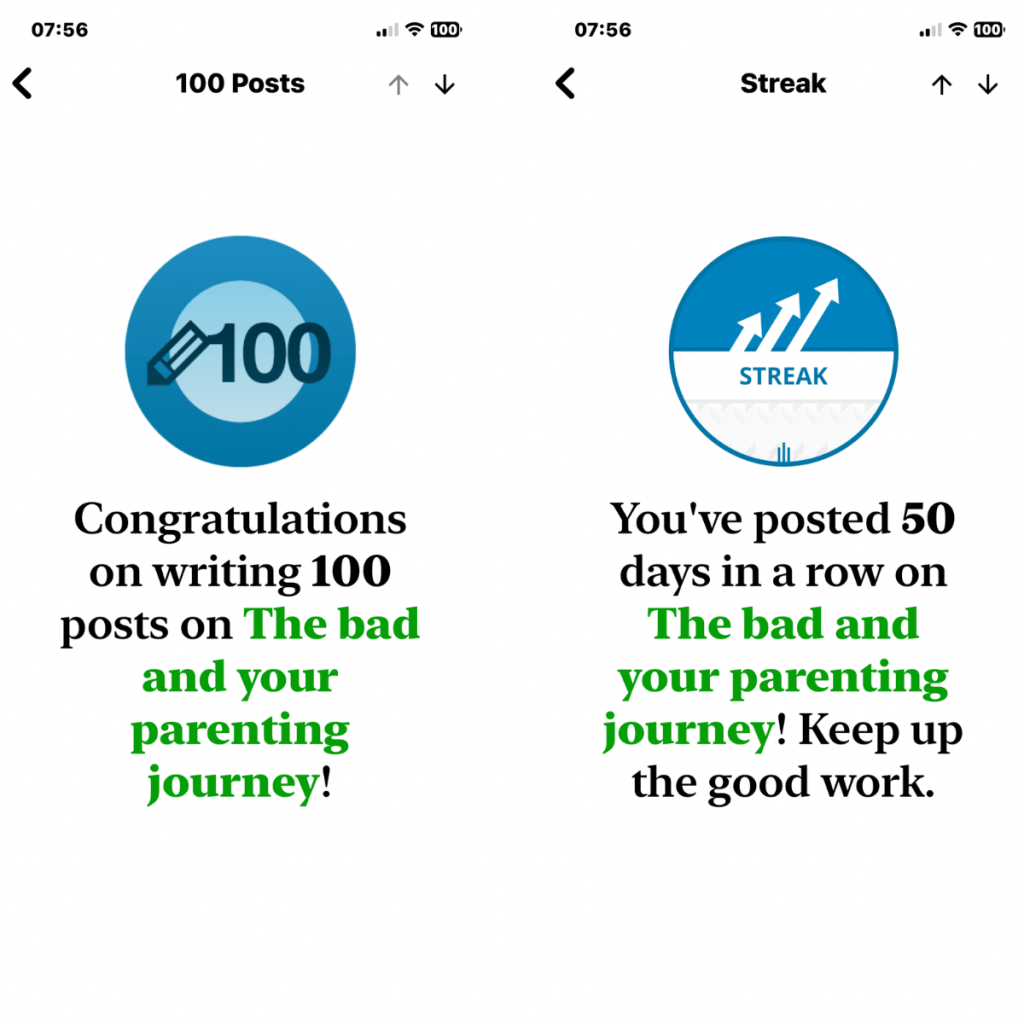
The Power of Consistency – 100 Blogs and 50 Days in a Row!

Consistency is one of the hardest things to maintain, especially when life throws challenges your way. But today, I’m celebrating a milestone that reminds me why showing up matters—I’ve written 100 blog posts on The Good, The Bad, and Your Parenting Journey, and I’ve posted every day for the last 50 days.

I was shocked I got these both on the same day!!!!

When I started this blog, my goal was simple: to create a space where parents—especially those navigating prematurity, neurodiversity, and the emotional rollercoaster of parenting—could find support, knowledge, and a sense of community. Writing has become my way of reaching out, sharing personal experiences, and letting others know they’re not alone.

Why Consistency Matters

There have been days when sitting down to write felt impossible—days when exhaustion, self-doubt, or the chaos of life made me question whether I had anything valuable to say. But I kept going, and along the way, I learned a few important lessons:

1. Progress Happens in Small Steps – Each post may feel like a tiny drop in the ocean, but together, they create waves.

2. Showing Up Builds Trust – Readers come back when they know they can rely on you to be there.

3. Growth Comes from Commitment – Writing every day has improved my skills, deepened my insights, and strengthened my connection with my audience.

A Thank You to My Readers

If you’ve been following along—thank you! Your support, comments, and encouragement mean everything. If you’re new here, I’d love for you to explore past posts and join this journey with me.

Whatever you’re working on—whether it’s parenting, writing, a passion project, or personal growth—consistency can take you further than you think. Keep going, even when it feels tough.

What’s something you’ve stayed consistent with that has made a difference in your life? I’d love to hear your experiences!

If you’ve found value in this blog, don’t forget to like, share, and subscribe to stay updated.

#ParentingJourney #BloggingMilestone #ConsistencyMatters #TheGoodTheBadAndYourParentingJourney

No Surrender: A Life Defined by Survival and Determination

Life is full of battles—some we expect, and others take us by surprise. My story is one of survival, resilience, and an unshakable determination to never give in. From being born prematurely at just 28 weeks to surviving sepsis as an adult, my journey has been anything but ordinary. And yet, through every challenge, I have found purpose, strength, and a drive to help others facing similar struggles.

Born Too Soon, Fighting From the Start

I entered the world far too early, in an era when neonatal medicine was still in its infancy. At 28 weeks and five days, survival was not guaranteed. My twin brother, Nicholas, didn’t make it, and his loss became a silent part of my story, shaping me in ways I wouldn’t fully understand until much later.

Prematurity came with its battles—learning to walk, struggling with reading, feeling out of place, and facing the invisible challenges of neurodiversity. But from the very beginning, I refused to give in.

A Second Fight for Life

Surviving birth was only the beginning. Years later, in 2019, I found myself facing death again—this time from sepsis. I was just 15 minutes away from not making it. The infection ravaged my body, pushing me to the edge. But just as I had done before, I fought. I survived. And with that survival came an even deeper understanding of life’s fragility and the importance of advocating for better awareness of serious illnesses like sepsis.

Turning Pain into Purpose

Survival doesn’t come without scars. The trauma of losing Nicholas, the struggles of being born premature, and the near-death experience of sepsis left me with anxiety, PTSD, and a determination to turn my pain into something meaningful.

Becoming a mother to my own premature baby, Amelia, reinforced this purpose. I knew firsthand the fear of the NICU, the uncertainty of every breath, and the financial and emotional strain of having a baby born too soon. I didn’t want other parents to feel alone in that journey, so I began sharing my story, writing books, and creating a space where families of premature and neurodivergent children could find support, understanding, and hope.

No Surrender: A Life Defined by Survival and Determination

This is more than just the title of my biography—it’s the essence of who I am. I have never surrendered to the odds, to the pain, or to the fear. My story is proof that survival is possible, that we can rise above even the hardest battles, and that our struggles can shape us into something stronger.

If my journey can offer even one person hope, then every challenge, every fight, and every survival has been worth it.

Have you faced a moment where you had to fight to survive? Let’s connect—your story matters, and you are not alone.

📢 Like, share, and subscribe for more stories of resilience, hope, and support for families of premature babies and neurodivergent children.

If there was a biography about you, what would the title be?

How My Parents Shaped Who I Am

When I think about the person I am today, I realise just how much of that is down to my parents. They were both teachers before they retired, and education was always at the centre of our home. My dad eventually became a headteacher, and from an early age, I was instilled with the belief that learning was essential—especially for children. But beyond academics, my parents also taught me something even more important: the power of advocacy.

The Importance of Advocacy

From the moment I started school, my mum became my biggest advocate. I don’t remember this myself, but when I was seven, I was assessed for dyslexia. The results were inconclusive—not because there wasn’t evidence, but because I couldn’t read yet. Looking back, that should have been a clear sign that something was wrong, but in the 1980s, understanding of dyslexia was far more limited.

I also relied heavily on lip reading when I was younger, something that wasn’t always recognised in the classroom. When I was in Infant 1 (the equivalent of Year 1 today), my teacher would look at the class while speaking, allowing me to follow along. But when she told us to put our heads down to work, I would do exactly that—unaware that she was still giving instructions. Three times, I was told off for not listening, and eventually, my mum received a letter home.

She wasted no time. The next day, she went straight to the school to speak with the teacher.

“Laura is deaf. That’s why she’s not responding. You need to tap her on the shoulder or let her know when you’re speaking to her.”

The teacher’s response? “I don’t believe you. I will only believe it when I see a doctor’s note.”

That very day, I had an appointment with my consultant, and my mum made sure to get a letter confirming my hearing loss. The next day, she took it into school. The teacher barely acknowledged it—there was no apology, just dismissiveness. But my mum didn’t back down, and because of her, the school had no choice but to accommodate me.

Fighting for My Hearing Aids

Of all the times my mum fought for me, one of the most important was when I was nine and struggling in school. I had undergone numerous operations, and during an appointment with my consultant, he told us there was nothing more they could do. His exact words were, “You’ll just have to live with it.”

But my mum wasn’t willing to accept that.

“What about hearing aids?” she asked.

His response was shockingly ableist: “Oh, we didn’t think you’d want her to be different.”

My mum’s reply was simple but powerful: “She can’t hear. She’s already different. She’s struggling, and I believe that if she has a hearing aid, she’ll be able to catch up.”

And she was right. Once I got my hearing aids, everything changed. I could finally access the world in a way I never had before.

A Teacher and an Advocate

Although my mum was a maths teacher, she was also so much more than that. She was my advocate, my champion, and the reason I was able to navigate a world that wasn’t built with people like me in mind. She taught me the importance of standing up for what’s right, of pushing for the support that children need, and of never accepting “no” as the final answer when something can be done.

My parents shaped who I am—not just by teaching me the value of education but by showing me how to fight for myself and for others. And for that, I am forever grateful.

If this story resonated with you, I’d love to hear from you. Have you had to advocate for yourself or your child in education? Let’s keep the conversation going—like, share, and subscribe to my blog for more stories and insights on parenting, neurodiversity, and advocacy.

What were your parents doing at your age?

Why Neonatal Leave and Extended Maternity Pay Matter for Families in the NICU

Bringing a baby into the world should be a time of joy and excitement. But for parents of premature or sick babies who require neonatal care, this experience can be filled with fear, stress, and financial hardship. Many families face a heartbreaking reality: they must return to work far too soon or risk falling into debt while their baby fights for survival in the neonatal intensive care unit (NICU).

Neonatal leave and extended maternity pay could change this. These policies would provide families with the financial security they need to focus on what truly matters—their baby’s health and development.

The Financial Struggles of NICU Families

When a baby is born prematurely or with medical complications, parents are often forced to take extended leave from work. Unlike full-term births, where maternity and paternity leave are planned, NICU stays are unpredictable and can last for weeks or even months.

Research from Bliss, a UK charity for premature and sick babies, shows that many parents go into debt due to the additional costs of having a baby in the NICU. Travel expenses, accommodation, food, and unpaid leave all contribute to financial strain. Some parents even have to return to work while their baby is still in intensive care, unable to be by their side during critical moments.

For me, this issue is personal. When my daughter, Amelia, was born prematurely, my husband, Ryan, reduced his working hours to four days a week so he could spend as much time as possible with us. He didn’t take his paternity leave right away because he wanted to use it when we could actually be home as a family. Instead, he commuted to the hospital while working part-time, and we relied heavily on Ronald McDonald House for accommodation. Even with this support, the financial burden was overwhelming.

The Emotional Toll of Returning to Work Too Soon

Beyond the financial impact, being forced back to work too early can take a huge emotional toll on parents. The NICU experience is traumatic, and many parents struggle with anxiety, PTSD, and postnatal depression. Leaving a fragile baby in hospital while returning to work isn’t just difficult—it’s heart-wrenching.

In the UK, maternity leave is up to 52 weeks, but statutory maternity pay drops significantly after the first six weeks. For families of NICU babies, this timeline doesn’t account for the reality of extended hospital stays and the need for additional recovery time.

Neonatal leave would allow parents to stay with their baby for longer without sacrificing financial stability. This support is not a luxury—it’s a necessity.

How Neonatal Leave and Extended Maternity Pay Can Help

Introducing neonatal leave and extending maternity pay would:

• Provide additional paid leave for parents of babies in neonatal care, ensuring they don’t have to choose between work and being with their baby.

• Reduce financial stress for families, preventing them from going into debt due to hospital-related costs.

• Support parents’ mental health by allowing them the time they need to recover from birth trauma and the stress of the NICU experience.

• Improve long-term outcomes for premature and sick babies, as parental presence has been shown to aid in bonding and development.

How You Can Help

Change is possible, but it requires action. If you believe that parents of premature and sick babies deserve better support, here’s how you can help:

1. Raise Awareness – Share this blog and talk about neonatal leave with friends and family. The more people who understand the issue, the stronger the movement becomes.

2. Contact Your MP – Write to your local MP urging them to support neonatal leave and extended maternity pay. (Bliss has a template letter you can use.)

3. Support Organisations – Charities like Bliss and The Smallest Things are campaigning for these changes. Donating or volunteering can make a real difference.

No parent should have to choose between financial stability and being with their baby during the most critical time of their life. Let’s work together to ensure that neonatal leave and extended maternity pay become a reality.

Like this post? Subscribe to my blog for more content on prematurity, neonatal care, and supporting families through difficult times.

References

• Bliss (2023). The financial impact of having a baby in neonatal care. Retrieved from www.bliss.org.uk

• The Smallest Things (2023). Why neonatal leave matters. Retrieved from www.thesmallestthings.org

If you had the power to change one law, what would it be and why?

Finding Our Perfect Home: A Space for Amelia to Grow

Last year, Ryan, Amelia, and I moved into what truly feels like our dream home—a two-bedroom flat that’s close to Ryan’s work and everything we need. After spending so much time in our previous home, a one-bedroom apartment, we realised that as much as we loved it, it simply wasn’t practical for us as a growing family.

The Challenge of a One-Bedroom Apartment with a Baby

When Amelia was born, we made our one-bedroom apartment work, but it quickly became clear how much space a baby needs. From her cot to changing supplies, toys, and clothes, we were constantly trying to find ways to store everything without feeling overwhelmed. Most importantly, Amelia had to sleep in the same room as us, which meant she didn’t have the independence to develop her own sleep routine. As she got older, we knew that she would need her own space—a place to call her own, to feel safe, and eventually to grow into.

The Joy of Our New Home

Now, in our two-bedroom flat, everything feels so much better. Amelia has her own room, which has already made such a difference in her sleep and overall routine. It’s her space, filled with her favourite things, and as she grows, it will become even more important for her sense of independence.

Another huge benefit is our garden—a large back garden where Amelia will be able to play in the spring, summer, and autumn. I can already picture her running around, exploring, and making memories outside, which is something we couldn’t have provided in our old home.

Feeling Truly Blessed

Moving into this home has been such a positive change for our family. When you have a baby, you don’t always realise just how much space they’ll need as they grow, but having this extra room has given us all the space to breathe. Ryan and I feel incredibly lucky that we were able to find a home that fits us so perfectly, and we’re excited to see Amelia grow up here.

Have you recently moved with a baby or young child? How did it impact your family? Let’s share experiences—leave a comment below! And if you found this blog helpful, don’t forget to like and subscribe for more posts about parenthood, family life, and navigating the challenges of raising little ones.

Write about your dream home.

From Shock to Relief: The Journey from Our 20-Week Scan to 30 Weeks

Pregnancy is a rollercoaster—one moment you’re filled with excitement, the next you’re drowning in uncertainty. I felt this shift most profoundly between my 20-week scan and my 30-week scan.

At 20 weeks, I had been looking forward to sharing the excitement of finding out whether we were having a boy or a girl. My weight management group had been buzzing with anticipation, ready to celebrate with me. But when I walked into the session after my scan, the joy they expected to see on my face was nowhere to be found. Instead, they saw shock, fear, and confusion.

That appointment had changed everything. Instead of a simple gender reveal, we had been hit with news we never expected—news that made the rest of my pregnancy feel fragile, unpredictable, and completely out of our hands.

The Turning Point: Our 30-Week Scan

Fast forward to 30 weeks, and everything shifted again. We had been under the care of St George’s Hospital, facing the harsh reality that we might have to deliver Amelia as early as 23 weeks. That fear had followed us through every appointment, every restless night, every moment we tried to prepare for the unknown.

Then came the news that changed everything. At our 30-week scan, we were told:

“You will need to have Amelia at 32 weeks, no later.”

We had made it to 30 weeks. We had more time than we ever thought we would. And most importantly, we weren’t aiming for 23 weeks anymore.

We were also re-referred to the Princess Anne Hospital, and for the first time in what felt like forever, I felt relief. The weight we had been carrying—the constant fear of the worst-case scenario—began to lift.

The Ones Who Shared Our Hardest Moments Shared Our Joy Too

When it came to sharing the news, we knew exactly who we wanted to tell. It was the same people who had stood by us through the hardest times:

• My mum, dad, brother, and sister—the ones who had been on this journey with us from the start.

• Ryan’s mum, dad, and sister—who had been a pillar of strength for us both.

• My two best friends from my cruise ship days—friends since 2007, the kind of people who are more like family than friends.

• And, of course, my weight management group—the women who had seen me at my lowest, my most vulnerable, my most terrified.

They had been there when I walked into our session at 20 weeks, barely able to speak, completely dazed. They had held space for me through every uncertainty, every fear. And now, they were the first ones I wanted to tell the good news to.

Because true friends aren’t just there for the struggles—they are there for the victories too.

From Fear to Hope

That 30-week scan was a turning point in my pregnancy. It reminded me that even when the road ahead feels terrifying, there is always the possibility of hope. And that hope feels even more powerful when you have people to share it with.

We had made it further than we had ever expected. And while we still had challenges ahead, for the first time in a long time, we had hope.

If this post resonates with you, please like, share, and subscribe for more personal stories and support for parents navigating the highs and lows of pregnancy, prematurity, and beyond.

You get some great, amazingly fantastic news. What’s the first thing you do?

Finding My Voice Again: How Sepsis Changed My Love for Singing

When I was younger, singing was one of my greatest joys. I loved music, the way it could transport me to another place, the way it made me feel free. I would sing anywhere and everywhere—karaoke nights, in the car, at home. I even had the privilege of singing for guests when I worked in the spa on Windstar cruises. It was a moment of pure joy, sharing music with people from all over the world, feeling the connection that only a song can bring.

But then, life took a turn I never expected.

In 2019, I had sepsis. I was fifteen minutes away from not surviving. The experience left me with more than just physical scars; it left behind a battle with post-sepsis syndrome, PTSD, and a deep-seated fear that still lingers. The worst part was the breathing. I had drains in my neck during my illness, and something about that experience changed the way I felt when I tried to sing. The breath control that once came so naturally now felt restricted. Singing, something that had once been effortless, now made me feel like I couldn’t breathe.

At first, I didn’t understand what was happening. I’d start to sing, and suddenly, my chest would tighten. The breathlessness would creep in, and then the memories would follow—the hospital room, the tubes, the panic of not being able to get enough air. Flashbacks would hit me like a wave, and I’d be right back in that place where my life hung in the balance.

Sepsis took many things from me, but I never expected it to take my voice.

For a long time, I avoided singing. It was easier that way. Every time I thought about it, fear took over, and I pushed it aside. But part of me missed it deeply—the way music had once been a source of joy and comfort. I knew I couldn’t let sepsis take that from me too.

So, I started small. I hummed to my daughter, Amelia, at bedtime. I sang softly when no one was listening. I reminded myself that it was okay if my voice wasn’t what it used to be, that it was okay to take things one step at a time.

And that’s the thing about healing—it’s not always about getting back to where you were. Sometimes, it’s about finding a new way forward.

I don’t know if I’ll ever be able to sing like I once did, but what I do know is that I’m not going to let fear silence me completely. My voice may be different, but it’s still mine. And as long as I can, I will keep finding ways to use it—not just in song, but in sharing my story, in helping others who feel like they’ve lost a part of themselves too.

If you’ve ever lost something you loved—whether it’s your voice, your confidence, or a part of yourself you thought was unshakable—know that you’re not alone. Healing isn’t about going back; it’s about moving forward in a way that honours who you are now.

And maybe, just maybe, I’ll find my way back to singing again.

Call to Action

Have you ever lost something you loved because of illness or trauma? How did you find your way forward? I’d love to hear your story. Share your thoughts in the comments below, and don’t forget to like and subscribe for more conversations on healing, resilience, and finding hope in the unexpected.

Are there any activities or hobbies you’ve outgrown or lost interest in over time?

What’s Your Favourite Candy? The Sweet Debate!

When it comes to sweet treats, everyone has their favourite. Some love a classic bar of chocolate, while others crave the tangy kick of sour sweets or the nostalgia of boiled sweets from childhood. But for me, it has to be chocolate—without a doubt.

After spending time working on cruise ships and travelling through Costa Rica and the US Virgin Islands, I came to a surprising realisation: Cadbury chocolate just doesn’t taste the same outside of the UK. In fact, I’d go as far as to say it’s a bit… gross.

Why Does Cadbury Taste Different Abroad?

If you’ve ever travelled and tried to satisfy a chocolate craving with a familiar brand, you might have noticed something was off. That’s because chocolate recipes are adjusted for different countries based on local ingredients and regulations. In the US, for example, Cadbury’s recipe is different due to food manufacturing laws, which means it lacks that smooth, creamy taste we all know and love here in the UK.

So, after all that time away, one of the things I was most chuffed about when I got home was being able to enjoy a proper Cadbury Twirl again.

The Ultimate Chocolate Experience – Easter Edition

While Twirls are an everyday favourite, if we’re talking about the best chocolate of the year, Easter is the time to indulge. Why? Cadbury Creme Eggs.

There’s something about the gooey fondant centre wrapped in that perfect layer of milk chocolate that makes it a treat I look forward to every year. Whether you eat yours in tiny bites, crack it open and scoop out the filling, or just pop the whole thing in your mouth (no judgement!), there’s no denying it’s a classic.

What’s Your Favourite Sweet Treat?

Are you a chocolate lover like me, or do you prefer something completely different? Maybe you’re a fan of retro sweets, or you can’t resist a bag of fizzy cola bottles. Let me know in the comments!

If you love chatting about all things food, parenting, and life, make sure to like and subscribe for more posts like this.

Call to Action:
 What’s your go-to sweet treat? Let’s talk chocolate, sweets, and everything in between in the comments!

What’s your favorite candy?

Design a site like this with WordPress.com
Get started